 |
 |
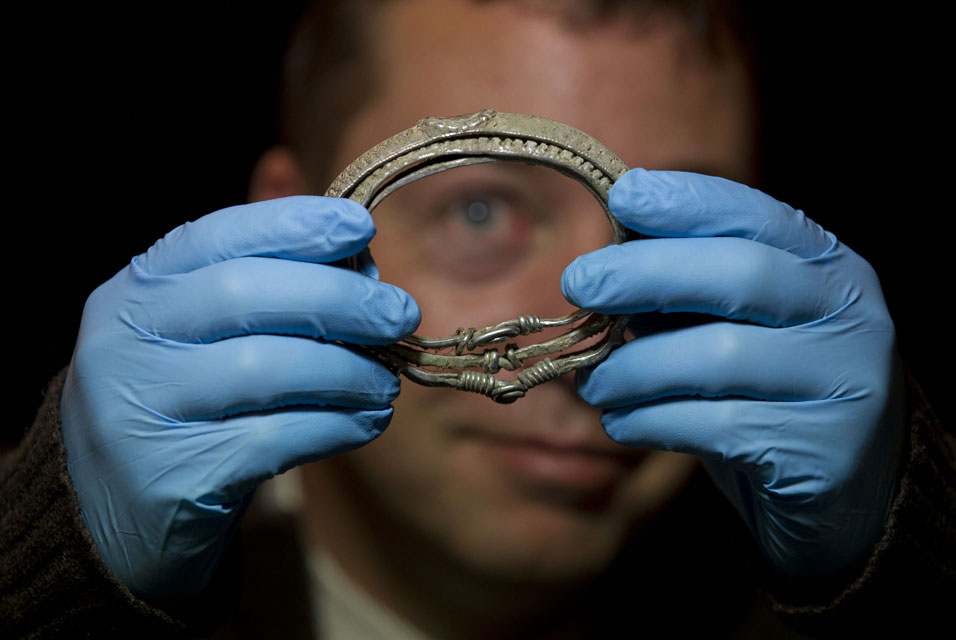
| LONDON.- Metal detectorist Darren Webster poses for photographs with a Viking arm-ring he discovered, estimated to date back to the late ninth, early tenth century, at the British Museum in London, Wednesday, Dec. 14, 2011. The arm-ring is part of the Silverdale Viking Hoard discovered by Webster in September 2011 in the Silverdale area of North Lancashire, England. It comprises of 201 silver objects including arm-rings, coins, finger-rings, ingots (metal bars), brooch fragments and a fine wire braid. AP Photo/Matt Dunham. |
Mostrando postagens com marcador arqueologia. Mostrar todas as postagens
Mostrando postagens com marcador arqueologia. Mostrar todas as postagens
quinta-feira, 15 de dezembro de 2011
Viking arm-ring


Mexican archaeologists find original offering on the site of Teotihuacan pyramid

Experts followed an old tunnel dug through the pyramid by researchers in the 1930s that narrowly missed the center, and then dug small extensions and exploratory shafts off it. Photo: INAH.
 Experts followed an old tunnel dug through the pyramid by researchers in the 1930s that narrowly missed the center, and then dug small extensions and exploratory shafts off it. Photo: INAH. By: Mark Stevenson, Associated Press | |
MEXICO CITY (AP).- Archaeologists announced Tuesday that they dug to the very core of Mexico's tallest pyramid and found what may be the original ceremonial offering placed on the site of the Pyramid of the Sun before construction began. The offerings found at the base of the pyramid in the Teotihuacan ruin site just north of Mexico City include a green serpentine stone mask so delicately carved and detailed that archaeologists believe it may have been a portrait. The find also includes 11 ceremonial clay pots dedicated to a rain god similar to Tlaloc, who was still worshipped in the area 1,500 years later, according to a statement by the National Institute of Anthropology and History, or INAH. The offerings, including bones of an eagle fed rabbits as well as feline and canine animals that haven't yet been identified, were laid on a sort of rubble base where the temple was erected about A.D. 50. "We know that it was deposited as part of a consecration ritual for the construction of the Pyramid of the Sun," said INAH archaeologist Enrique Perez Cortes. Experts followed an old tunnel dug through the pyramid by researchers in the 1930s that narrowly missed the center, and then dug small extensions and exploratory shafts off it. What they found points to the earliest days of the still largely mysterious Teotihuacan culture. The remains of three structures that predate the pyramid were found buried at the base. Archaeologists have known that the ceremonial significance of the site, perhaps as a "link" to the underworld, predates the pyramids. They also found seven burials, some of them infant remains. Susan Gillespie, an associate professor of anthropology at the University of Florida who was not involved in the project, called the find "exciting and important, although I would not say it was unexpected" given that dedicatory offerings were commonly placed in MesoAmerican pyramids. "It is exciting that what looks like the original foundation dedicatory cache for what was to become the largest (in height) pyramid in Mexico (and one of the largest in the world) has finally been found, after much concerted efforts looking for it," Gillespie wrote in an email. She said the find gives a better picture of the continuity of religious practices during Teotihuacan's long history. Some of the same themes found in the offering are repeated in ancient murals painted on the city's walls centuries later. George Cowgill, an anthropologist at Arizona State University, called the find "pretty important" and suggested the Tlaloc offerings may thicken the debate about whether the pyramid was linked to the sun, the underworld or Tlaloc, who was also considered a war god. "The discovery of seven humans suggests that they were probably sacrificial victims, along with several species of fierce animals," Cowgill wrote. The city was founded nearly 2,500 years ago and came to have a dominant influence in architecture, trade and cultural in large swaths of ancient Mexico. But the identity of its rulers remains a mystery, and the city was abandoned by the time the Aztecs arrived in the area in the 1300s and gave it the name Teotihuacan, which means "the place where men become gods." Copyright 2011 The Associated Press. |
quinta-feira, 8 de dezembro de 2011
Inês Raphaelian - Expedição Montemor-o-Novo
Expedição Montemor-o-Novo
Objectos de repertório iconográfico do património arqueológico da região de Montemor-o-Novo - as placas de xisto - onde estão presentes imagens geométricas, agora vêem-se circuito impressos de *chips* e componentes característicos da tecnologia contemporânea dos microcomputadores.
Esta nova iconografia constrói um novo imaginário, um discurso enigmático, objectos atemporais.
A proposta é parte integrante do projecto "B.C. Byte Series" de Inês Raphaelian, que constrói uma ficção poética onde o passado e o presente se fundem num só tempo. Estes objectos são concebidos como "achadas" arqueológicos em pontos significativos de Montemor-o-Novo eleitos como um sítio arqueológicos ficcional. Os objectos, os registos fotográficos realizados e os conteúdos científicos relacionados, isto é, o resultado do projecto será posteriormente incluído no sítio web www.raphaelian.net
projecto | coordenação
Inês Raphaelian
realização | captação | montagem
Rui Cacilhas
equipa
Ana Cravosa | Carlos Carpetudo | Hermínia Santos | José Bexiga | Mafalda Fernandes | Maria Manuel | Nelson Santos | Pedro Grenha | Sira Camacho | Tiago Fróis
agradecimentos
Ana Cravosa | Anabela Ferreira | Carlos Carpetudo | Elvira Barrelas | Fátima Lima | Hermínia Santos | Jaime Lagoa | João Bastos | Joaquim Pimentão | José Bexiga | Lena Marques | Leandro Projecto | Luciane Guará | Mafalda Fernandes | Mafalda Machado Rosário | Manuel Calado | Manuel Casa Branca | Maria Manuel | Marta Mattioli | Miguel Machado Rosário | Nelson Santos | Nuno Lemos | Paulo Xavier | Pedro Grenha | Renato Pera | Rui Cacilhas | Sandra Coelho | Sira Camacho | Tiago Fróis | Vasco Silva | Virgínia Fróis | Faculdade Santa Marcelina
produção | Iniciativa
Oficinas do Convento, Associação Cultural de Arte e Comunicação
apoio
Municipio de Montemor-o-Novo
estrutura financiada
Ministério da Cultura e Dgartes
Assinar:
Postagens (Atom)