
terça-feira, 26 de fevereiro de 2013


Rodrigo Kassab - Priva-cidade, Publi-cité
Em exposição na GALERIA LUME, Rodrigo Kassab explora os limites entre espaços públicos e privados

A GALERIA LUME inaugura sua programação de exposições de 2013 com Priva-cidade, Publi-cité, de Rodrigo Kassab, na qual são exibidas pela primeira vez todas as fotografias da série que dá nome à mostra.Esse conjunto de fotografias é composto por imagens de linhas paralelas que delineiam fachadas de prédios e as janelas, que são o cerne dessas fotografias. Em Priva-cidade, Publi-cité, o artista faz uma investigação dos limites e das relações entre os espaços públicos e os privados. “Percebi que este limite estava muito presente em cortinas e janelas, e, ao fotografá-las, poderia colocar o espectador entre esses dois espaços, como um voyeur, mas sem o elemento fetiche do voyeurismo, que é o medo de ser percebido”, explica Rodrigo.Com influência do construtivismo, grande inspiração para Priva-cidade, Publi-cité é a arquitetura, analisada sob o espectro de reflexo humano e interação social, além do fator efemeridade, visto que as construções fotografadas para a série podem deixar de existir em algum momento, dando lugar a novas histórias, compartilhadas com o mundo, acidentalmente ou não, através das janelas.
Exposição: Rodrigo Kassab – Priva-cidade, Publi-citéCuradoria: Paulo Kassab Jr.Coordenação: Felipe HeggAbertura: 05 de março de 2013, terça-feira, às 19h30Período: de 06 a 25 de março de 2013Local: GALERIA LUME – www.lumephotos.com Rua Joaquim Floriano, 711 - 2º andar – Itaim Bibi – São Paulo, SP Tel.: (11) 3704.6268Horário: segunda a sexta das 10h às 20h
The pen and ink with crayon by Lucian Freud

The pen and ink with crayon by Lucian Freud (British, 1922-2011) titled ‘Oil-bound Puffin’ is signed and dated 'Lucian Freud/Oct 44' and is estimated to sell for £200,000-300,000. Photo: Bonhams.
LONDON.- Nothing was exempt from the intense scrutiny of Lucian Freud, rotund ladies, his mother, his daughters in the nude and a moribund puffin, now for sale at Bonhams Modern British and Irish art auction on May 29th in New Bond Street. The pen and ink with crayon by Lucian Freud (British, 1922-2011) titled ‘Oil-bound Puffin’ is signed and dated 'Lucian Freud/Oct 44' and is estimated to sell for £200,000-300,000. A grandson of Sigmund Freud, Lucian Freud arrived in England with his family from Berlin in 1933 at the age of ten. This drawing by one of the worlds most sought after artists was executed when he was just 22 and is consigned from an important private London collection. It was exhibited in London at the Alex Reid & Lefevre Gallery in November 1944, which was the artist’s first exhibition, and sold for 13 guineas. Already one can see the unremitting and forensic accuracy he is known for. During his early career Freud preferred working on paper to painting, as in this exquisite example. He once said that he “did 200 drawings to every painting in those early days”. Matthew Bradbury, Director of the Modern British and Irish Art Department at Bonhams, comments: “The enormous appeal of ‘Oil-bound Puffin’ lies in the bird’s serenity and minute attention to detail of every single feather. Appearing at auction for the very first time and unseen in half a century the work will be exhibited at Bonhams in New York prior to sale in London”. Freud very early on established his own artistic identity in meticulously executed realist works, imbued with a pervasive distance. Most of his career was spent in Paddington, London, whose atmosphere is reflected in his often sombre and moody interiors and cityscapes. By the late 1950s he began to describe the face and body in terms of shape and structure, and often in female nudes the brushstrokes help to suggest shape. Throughout his career Freud's palette remained distinctly muted. A close relationship with sitters was often important for Freud. His mother sat for an extensive series in the early 1970s after she was widowed, and his daughters Bella and Esther modelled nude, together and individually. Although the human form dominated his output, Freud also executed cityscapes, viewed from his studio window, and obsessively detailed nature studies. The 1980s and early 1990s were marked by increasingly ambitious compositions in terms of both scale and complexity. More Information: http://artdaily.com/index.asp?int_sec=2&int_new=60972[/url] Copyright © artdaily.org
Selezione Femminile Plurale
| Selezione Femminile Plurale | ||
| ||
Donna faber
Nella pratica artistica contemporanea si registra un ritorno al lavoro manuale. Specie nell'altra metà del cielo, biologicamente e storicamente più vicina al corpo e al fare. E forse in questa ripresa della "pratica come attitudine artistica" agisce la distanza da alcuni eccessi concettuali. Anche se, come hanno insegnato i grandi, da Leonardo a Brunelleschi, è nella tecnica e nella manipolazione, che si origina un nuovo pensiero [di Paola Ugolini]
|
pubblicato lunedì 25 febbraio 2013
  Ma come si pone nell'attuale società contemporanea l'artista, un essere che per sua natura racchiude in sé le due anime distinte del faber e del sapiens? Una mostra al Castello Sforzesco di Milano dal titolo "Homo Faber, il ritorno del fare nell'arte contemporanea" ha cercato di fare il punto sull'importanza della riappropriazione da parte degli artisti del "fare" come espressione massima di creatività contrapposta quindi alla pratica "mentale" del concettuale che dal secondo dopoguerra ha privilegiato l'idea rispetto alla pratica. Il dualismo fra manualità e ideazione, che è da sempre al centro del dibattito artistico, in questi tempi di crisi economica e morale ha preso, soprattutto nei lavori degli artisti più giovani, un'interessante svolta verso la pratica del fare. Nel panorama artistico contemporaneo brillano per "manualità" alcune artiste che, letteralmente "sporcandosi le mani", hanno riportato la centralità del fare all'interno della loro ricerca, con tutta la fatica e il coinvolgimento fisico che comporta l'azione. E non è un caso che proprio le donne si siano riappropriate del fare manuale, azione che da sempre appartiene all'universo femminile.   
La tecnica intesa come "τέχνη" (téchne) è un concetto che risale all'antica Grecia, in origine la parola veniva usata per indicare una prerogativa specifica degli dèi che ne faranno dono agli uomini per sopperire alla loro debolezza. Le divinità possedevano le tecniche come qualità intrinseche che erano a loro sostanziali, come Efesto che possedeva il dono di saper forgiare i metalli o Athena dea della matematica e delle arti, ed erano quindi demiurgiche ovvero creatrici. Chi possiede la conoscenza tecnica crea. Gli artisti che fino al Rinascimento venivano considerati alla stregua degli artigiani, cominciano a elevare il loro status, e ad essere considerati socialmente alla pari dei letterati, dei poeti e poi dei nobili, quando si impadroniscono nuovamente delle tecniche scientifiche matematiche, fisiologiche, geometriche che gli permettono di indagare i segreti della materia e del corpo umano e quindi di creare. Brunelleschi può innalzare a Firenze una cupola grandiosa in soli sedici anni (dal 1420 al 1436) grazie alla téchne matematica e geometrica. Leonardo e Michelangelo, in virtù dello studio assiduo del corpo umano e la vivisezione dei cadaveri, creano con il marmo e i pennelli figure umane meravigliose e perfette.

*articolo pubblicato su Exibart.onpaper n. 82. Te l’eri perso? Abbonati!
|

Zipper Galeria na Feira Art13 em Londres
| |||||||||||||||||||||||||||||||||||


Abertas inscrições para oficinas culturais em Catanduva, SP
Neste ano, projeto oferecerá 90 opções de cursos em diversas áreas.
Aulas acontecem em dias e horários alternados, de acordo com escolha.
Estão abertas a partir desta segunda-feira (25), as inscrições para as Oficinas Culturais oferecidas pela Secretaria Municipal da Cultura de Catanduva (SP). Com prazo e horários ampliados, as inscrições podem ser feitas até 1º março, no horário das 8h às 22h, na Estação Cultura.
Neste ano, o projeto oferecerá 90 opções de cursos. Serão desenvolvidas diversas oficinas voltadas ao público infantil e à terceira idade, novas oficinas na área de dança, artes plásticas e artesanato, bem como duas novas modalidades: audiovisual e literatura.
As aulas acontecem em dias e horários alternados, de acordo com o curso que o aluno escolher. Para o primeiro semestre de 2013, serão oferecidas oficinas nas áreas de Artesanato, Artes Plásticas, Desenho Artístico, Dança, Literatura, Audiovisual, Teatro, Música, Oficinas para crianças, Oficinas para 3ª Idade e Oficinas de Férias. (Confira abaixo as oficinas completas).
Outras informações pelos telefones (17) 3531-5106 e (17) 3531-5107. A Estação Cultura fica na Rua Rio de Janeiro, nº 100. Confira abaixo as oficinas
Desenho ArtísticoPerspectivaOutras informações pelos telefones (17) 3531-5106 e (17) 3531-5107. A Estação Cultura fica na Rua Rio de Janeiro, nº 100. Confira abaixo as oficinas
Reprodução de Fotografia
Desenhando e Criando
Desenho Artístico
Cartum e Caricatura
AudiovisualProdução de vídeo
Vídeo debate
Oficina de Colagem para arte educadores e arteterapeutas - Ribeirão Preto - SP - Sílvio Alvarez
Oficina de Colagem
para arte educadores e arteterapeutas
ribeirão preto - silvio Alvarez
ribeirão preto - silvio Alvarez
Informações
A Oficina de Colagem com o artista plástico Silvio Alvarez acontecerá em Ribeirão Preto (SP) com carga horária de 3 horas.
Quem pode participar
Qualquer interessado no tema - serão priorizadas as inscrições de arteterapeutas, psicólogos, professores e alunos de arteterapia e psicologia
Conteúdo
História da Colagem - Artistas de Colagem brasileiros e internacionais - Técnica da Colagem - Confecção de material em sala de aula - A utilização da técnica como ferramenta em arteterapia.
Responsável
Facilitador - Silvio Alvarez
Paulistano, autodidata, dedica-se à técnica desde 1989. Sem ter, até então, demonstrado aptidão para outras formas de expressão artística, iniciou-se na colagem utilizando-a intuitivamente como instrumento de arteterapia em um momento difícil de sua vida.
Suas obras, em geral, tratam, com bom humor, a relação do homem com o meio ambiente, com o cotidiano das grandes cidades e com ele mesmo, compondo um mundo próprio, mágico e surreal e já estiveram expostas em Coletivas no Brasil e exterior (destaque para Feira do Louvre em Paris e Aeroporto de Guarulhos - Condomínio Conjunto Nacional)
Quando
23 de março
das 14h às 17h
Investimento
R$ 120,00
Informações e inscrições
(16) 30190595
(16) 88019618
carolinawiermann@gmail.com
(16) 88019618
carolinawiermann@gmail.com
Local
RIBEIRÃO PRETO (SP)
R. Mariana Junqueira, 623 - Centro
Fonte: Divulgação Gaia Brasil

SESC POMPEIA: 30 ANOS
 | SESC POMPEIA: 30 ANOS SESC Pompeia | |||||||||
| ||||||||||
 | ||||||||||
Integrando as comemorações dos 30 anos de abertura do Sesc Pompeia, a exposição, com concepção e coordenação geral dos arquitetos André Vainer e Marcelo Ferraz, que ainda na condição de estagiários, participaram da construção da fábrica desde o início até o fim da obra, procura mostrar como se deu esta incrível experiência e como durante os 30 anos de sua existência o Sesc Pompeia concretizou o ideal de convivência, entretenimento e lazer, estabelecendo-se como um dos mais importantes equipamentos urbanos da cidade de São Paulo. Será apresentada uma linha do tempo com a história da fábrica, desde sua antiga ocupação com a Mauser e Ibesa, a restauração proposta e executada pela arquiteta Lina Bo Bardi, informações específicas sobre os conceitos do mobiliário e estruturas da edificação e fatos curiosos. Também serão expostos vídeos com entrevistas de Lina Bo Bardi, maquete eletrônica e registros históricos de shows, eventos, exposições, realizados ao longo dos últimos trinta anos. Hall do teatro.
A exposição conta com um programa educativo. Visitas mediadas (agendamento e informações) na Central de Atendimento (11) 3871-7700 ou pelo e-mail agendamento@pompeia.sescsp.org.br | ||||||||||
| ||||||||||

Leilão de Arte Tableau - Fevereiro de 2013
 |
Tableau Arte & Leilões
|
|


segunda-feira, 25 de fevereiro de 2013

domingo, 24 de fevereiro de 2013
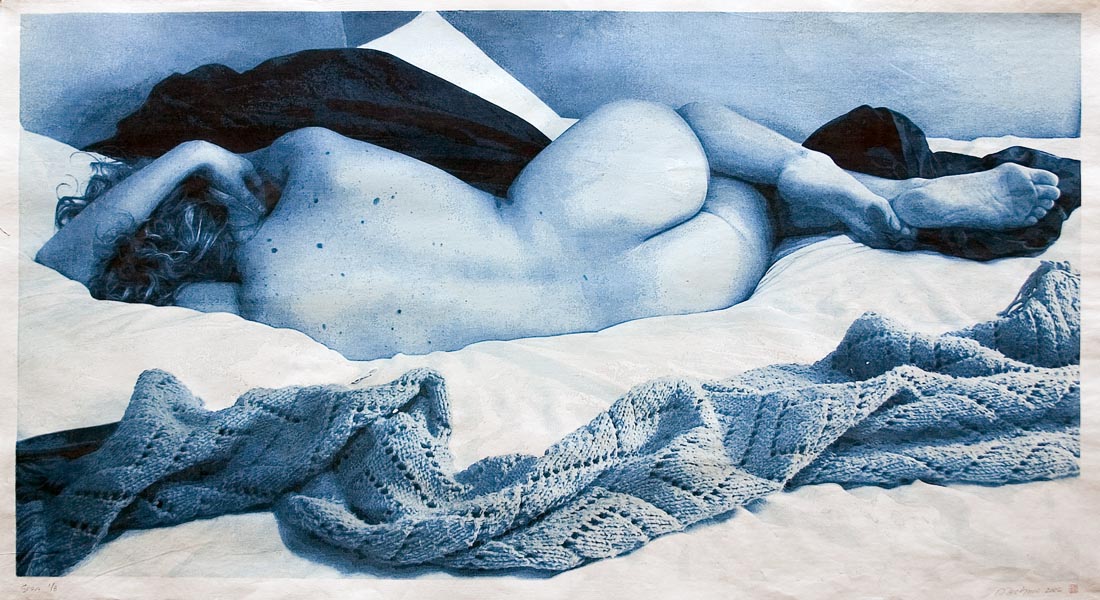
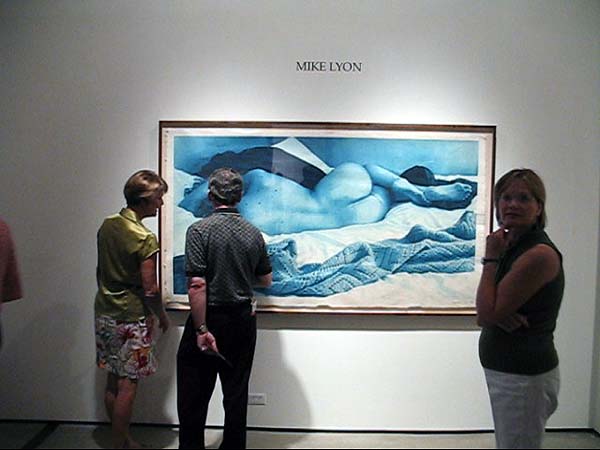
Mike Lyon - Sara - xilogravura
“Sara” 42×77 inch woodcut from 17 blocks
13 Comments
7,665 views
7,665 views
The large (42 x 77 inch) prints of “Sara” reclining on her messy bed have been successfully completed — I selected 8 for the edition plus two proofs. There is some variation among the edition, the greatest differences being in the depth of the deepest tones behind the head and in the top background — these were introduced when I used the baren to print one of the blocks, pressing too hard about half the prints resulting in some loss of color at the edges of the block forms. Something to remember for next time! But overall the ten printed sheets are reasonable uniform, all things considered.
video documents start-to-finish printing of one sheet around block four…
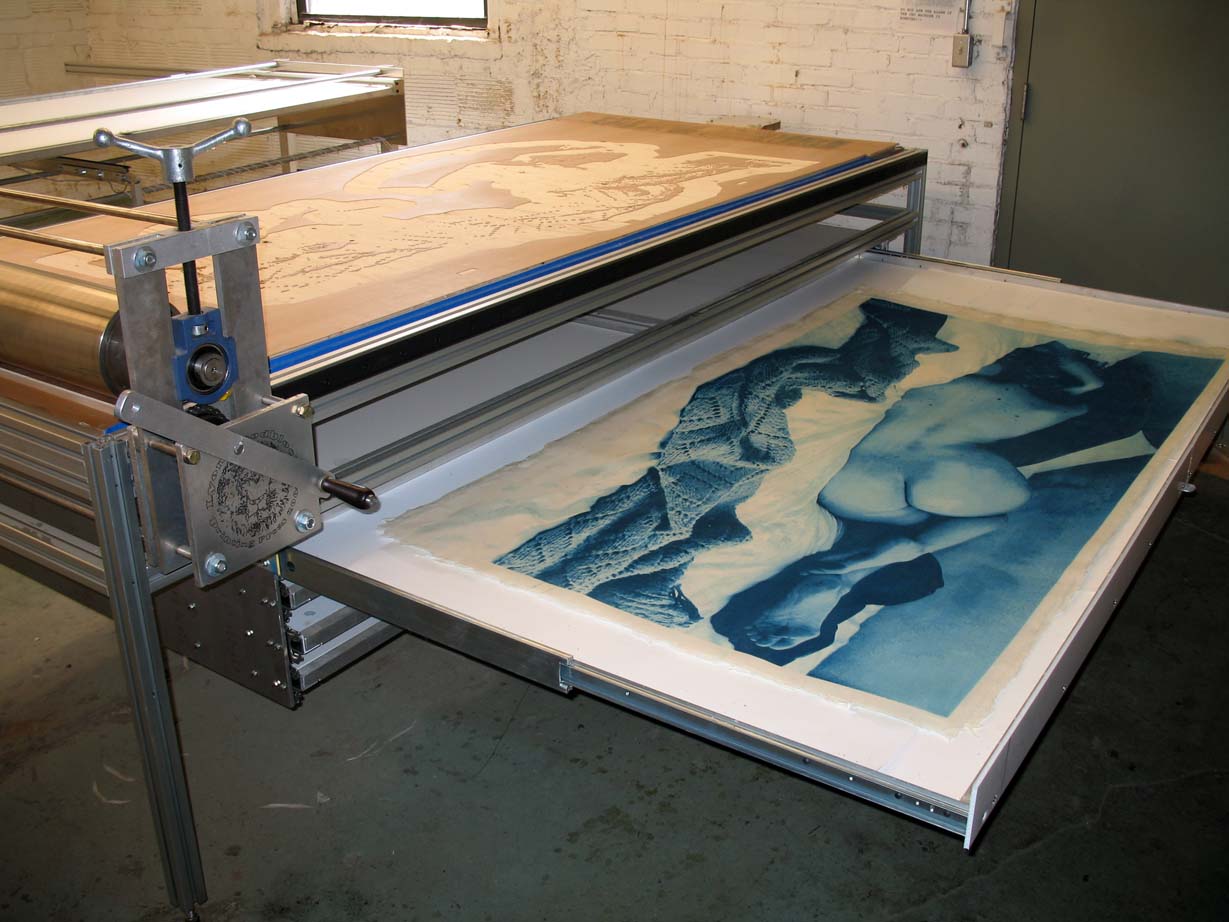

Good lord, it’s hot in my studio! I’m working on “Sara”, a 17 block woodcut on ten sheets of 42 x 77 inch Iwano Ichibei hosho paper. Sweaty work and EXHAUSTING!!! I’m managing to print about 3 or 4 blocks per day and that’s really all I am able to manage! But I’m getting better and better at using the large press I built about seven or eight months ago, even though this is only the third edition I’ve pulled on it.
I handled registration a bit differently this time… The blocks were carved with three identical side kento, each about 1 1/2 inches long, and the center of the middle one was inscribed with a very narrow line. I used a razor blade to produce three flat edges in the deckle of each sheet (parallel to the edge of the sheet)so that they’d line up with the kento in the blocks, and I drew a short pencil line in the center of the middle ‘notch’ to be lined up with the line inscribed in the middle kento. Surprisingly, this worked very well, and I found it easy to register each sheet to the blocks, aligning the pencil mark with the inscribed line on the block. At the far edges, this resulted in about +/- .05 inch of dead on which is plenty close for the image and the eye. Given the size of the sheets I’m not sure I can do much better than that…
– Mike

Assinar:
Postagens (Atom)